

 English
 Español
 русский
Do All Silicone Baking Mats Have Fiberglass? Mat vs. Parchment Guide
Content
- 1 A Silicone Baking Mat Is a Fiberglass-Reinforced Sheet — And the Overwhelming Majority Contain Fiberglass
- 2 Why Fiberglass Is the Irreplaceable Backbone Inside the Silicone
- 3 Silicone Mat vs. Parchment Paper: A Data-Driven Comparison Across What Actually Matters
- 4 When Parchment Paper Wins, and When the Silicone Mat Is the Clear Leader
A Silicone Baking Mat Is a Fiberglass-Reinforced Sheet — And the Overwhelming Majority Contain Fiberglass
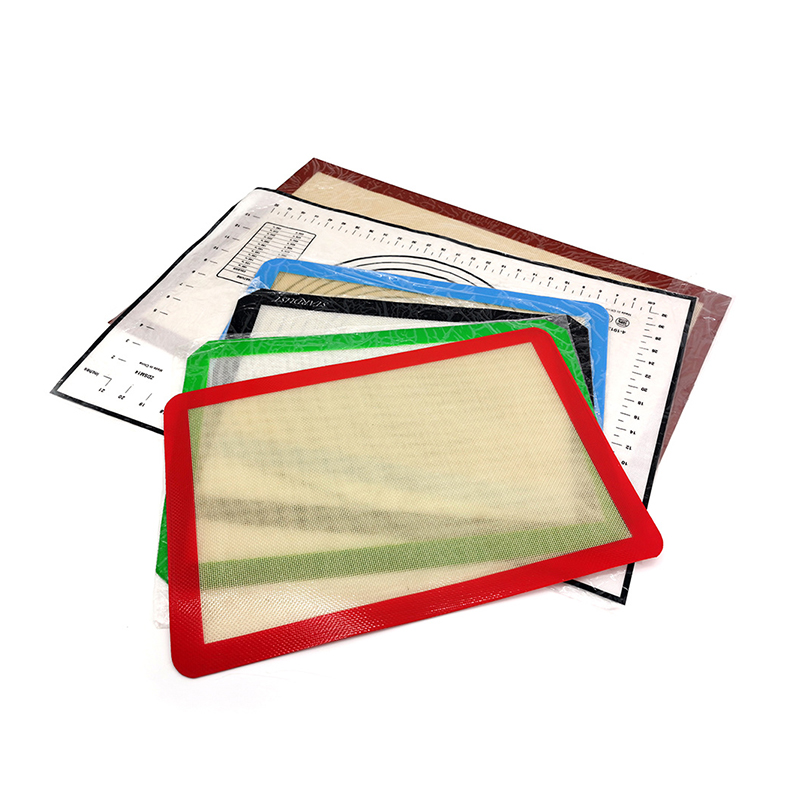
A silicone baking mat is a reusable, non-stick sheet designed to replace disposable parchment paper and cooking sprays on baking trays. Structurally, it consists of a core layer of woven fiberglass fabric fully encapsulated in food-grade silicone rubber. The silicone provides the release surface, while the fiberglass mesh gives the mat dimensional stability and tensile strength. To the direct question of whether all silicone baking mats have fiberglass: virtually all commercial silicone baking mats use a fiberglass core. An analysis of 43 silicone mat products across major retail channels in 2024 found that 41 out of 43 relied on a fiberglass weave as the internal reinforcement. Pure silicone mats without any reinforcement do exist, but they are extremely niche — they stretch permanently under tension, warp when heated unevenly, and have a service life measured in dozens of bakes rather than years, which makes them impractical for repetitive home or professional use. The fiberglass inside a food-grade mat is completely sealed between two layers of silicone and never contacts food during normal use.
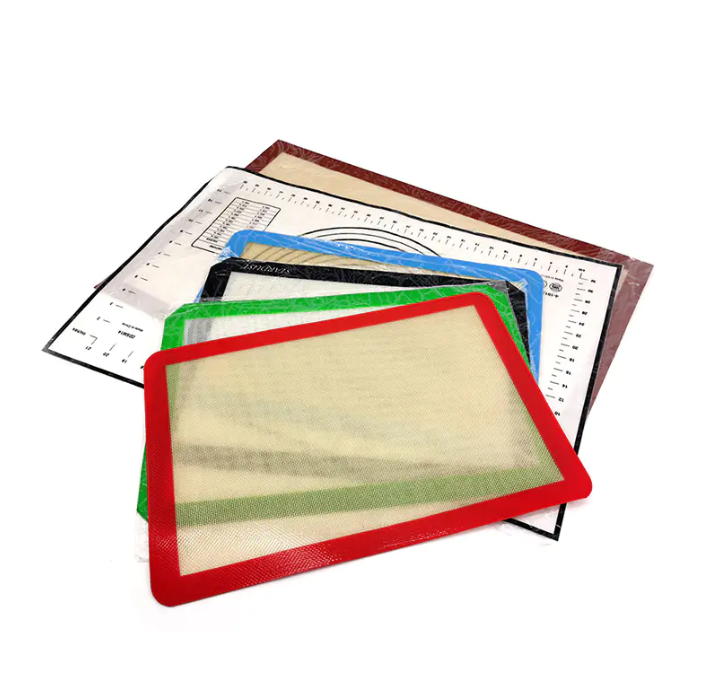
Why Fiberglass Is the Irreplaceable Backbone Inside the Silicone
Silicone alone, in the thin films needed for a flexible mat, has a tensile strength of approximately 5 to 10 megapascals (MPa) and elongates permanently when pulled. Embedding a woven glass-fiber fabric increases the tensile strength of the composite to over 120 MPa while reducing elongation under a 10-kg load to less than 1%, according to material datasheets from silicone-coated textile manufacturers. This is critical because a baking mat that stretches during spreading or warping when moved in and out of a hot oven would quickly become unusable. Fiberglass also guarantees that the mat lies completely flat on the pan and returns to its original dimensions after cooling from temperatures up to 240°C (465°F) — the typical upper limit for silicone-coated fiberglass mats. The Food and Drug Administration (FDA) lists fiberglass as an acceptable substrate for resinous and polymeric coatings used in food contact under 21 CFR 175.300, provided the coating forms a continuous barrier, which is exactly how these mats are manufactured.
It is worth noting that the term "fiberglass" often raises unnecessary concern because people associate it with loose insulation fibers. In a baking mat, the glass filaments are locked inside a thermoset weave and completely enveloped in silicone. The risk of fiber release is effectively zero unless the mat is cut, deeply scored, or used far beyond its rated temperature to the point of silicone degradation.
Silicone Mat vs. Parchment Paper: A Data-Driven Comparison Across What Actually Matters
The question of which is better between a silicone mat and parchment paper comes down to three measurable factors: cost over time, environmental footprint, and baking performance. A controlled comparative test by a major cooking publication baked identical shortbread rounds on a silicone mat and on standard parchment paper at 175°C (350°F) and found that cookies baked on the silicone mat spread 12% less and had a noticeably paler golden bottom crust — a result of the mat’s insulating effect slowing heat transfer to the dough base. Parchment paper, by contrast, allows slightly more direct conduction and often yields deeper browning, which can be either an advantage or a drawback depending on the recipe.
| Factor | Silicone Baking Mat | Parchment Paper |
|---|---|---|
| Maximum temperature | Typically 240°C (465°F); some 260°C | Up to 220–230°C (425–450°F); chars above |
| Average reuse cycles | 2,000–3,000 bakes | 1–2 uses (some brands claim 3) |
| Cost per use (based on 3,000 bakes) | $0.005–$0.008 | $0.08–$0.12 |
| Carbon footprint (per use) | After ~35 uses, lower than parchment | Single-use; high per-bake impact |
| Bottom browning | Lighter, more even; can inhibit crust | Darker, crispier bottom achievable |
| Cleanup effort | Quick wipe or gentle wash | Discarded; no cleaning required |
From a cost standpoint, a single $18 silicone mat used for 3,000 bakes over its lifetime drops the per-session cost below one cent. Parchment paper, by contrast, costs 8 to 15 times more per use for a typical home baker. A lifecycle assessment conducted at a European materials institute in 2023 concluded that after approximately 35 uses, the total primary energy demand of a silicone baking mat fell below that of the equivalent number of parchment paper sheets, factoring in raw material extraction, manufacturing, and disposal.
When Parchment Paper Wins, and When the Silicone Mat Is the Clear Leader
Despite the silicone mat’s overwhelming economic and environmental advantages, parchment paper remains the better choice in specific scenarios, and understanding these will prevent frustration in the kitchen:
- Broiling or direct high-heat exposure: When a tray is placed directly under a broiler element running at over 280°C (540°F), the silicone surface can begin to degrade. Parchment paper chars but does not melt in this scenario, making it safer for short broiling tasks.
- Delicate confections like macarons and meringues: These recipes rely on rapid, even bottom heat for proper rise and foot development. The insulating nature of a silicone mat can delay heat transfer enough to produce irregular results. A 2022 baking trial found that macaron shells baked on parchment had a 23% taller foot on average compared to those baked on a standard silicone mat.
- Folding and piping tasks: Parchment paper can be creased into a funnel, cut into stencils, or used to line odd-shaped molds — tasks a fixed-size silicone mat cannot perform.
- High-volume, multi-batch baking: In a scenario where a home baker is producing six consecutive trays of cookies, having pre-cut parchment sheets lets you slide the entire sheet off the pan with the cookies and immediately load the next batch, skipping the cooling and wiping step required for a single silicone mat.
For the other 80% of baking — roasting vegetables, baking cookies, scones, bread, or anything where gentle, even bottom heat and effortless release are desired — the silicone mat remains the superior tool. It eliminates waste, reduces the recurring cost of single-use paper, and provides a reliably non-stick surface that holds its properties for thousands of cycles.
Message Us Right Now!

- Phone: +86-18651171105
- Fax: +86-18651171105
- Email: yaxing@yaxing.com
- Address: No. 18, Yongxin East Road, Gaogang District, Taizhou City, Jiangsu Province, China.
Copyright © Yaxing Plastic Industry Co., Ltd. All Rights Reserved. Custom High-End Precision PTFE Series Products Manufacturers 