

 English
 Español
 русский

PTFE Open Mesh vs Stainless Steel Wire Mesh Belt: Energy, Weight, and Corrosion
Content
- 1 Why Compare PTFE Open Mesh and Stainless Steel Wire Mesh Belts?
- 2 Material Construction: PTFE Open Mesh vs Stainless Steel Wire Mesh
- 3 Weight: A Direct Impact on Tension, Drive Power, and Installation
- 4 Energy Saving: Air Permeability, Thermal Mass, and Drive Efficiency
- 5 Corrosion Resistance: Chemical Inertness and Cleaning Behavior
- 6 Strength, Load Capacity, and Mechanical Durability
- 7 How to Choose Between PTFE Open Mesh and Stainless Steel Wire Mesh
- 8 Frequently Asked Questions
- 9 Final Thought: Match the Belt to the Process
Why Compare PTFE Open Mesh and Stainless Steel Wire Mesh Belts?
Conveyor belt selection plays a central role in drying, curing, baking, and material handling lines. Two common options are PTFE open mesh conveyor belts and stainless steel wire mesh belts. Although they can sometimes perform similar jobs, their behavior in real operating conditions is quite different.
This guide compares PTFE open mesh conveyor belts with stainless steel wire mesh belts across three key areas: energy saving, weight, and corrosion resistance. The goal is to help engineers, maintenance managers, and process designers choose a belt that fits the actual production environment.
Material Construction: PTFE Open Mesh vs Stainless Steel Wire Mesh
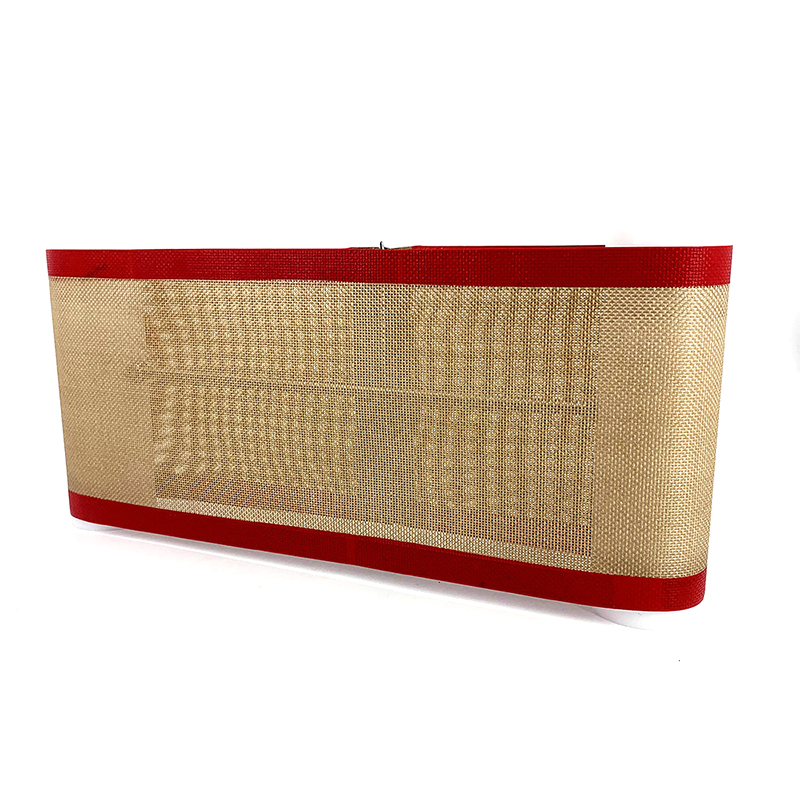
A PTFE open mesh conveyor belt begins with woven fiberglass fabric that is fully coated with PTFE. The open mesh structure leaves a significant percentage of open area, allowing hot air, steam, and moisture to pass through the belt. A stainless steel wire mesh belt, on the other hand, is made from interlocking metal wires that provide high strength, dimensional stability, and mechanical durability.
| Feature | PTFE Open Mesh Belt | Stainless Steel Wire Mesh Belt |
|---|---|---|
| Primary Material | Fiberglass fabric with PTFE coating | Interlocking stainless steel wire |
| Open Area | High breathability for airflow and moisture release | Depends on weave; often more closed and dense |
| Weight per Area | Lightweight | Heavy |
| Continuous Temperature | Up to about 260°C, depending on belt construction | Grade-dependent; many heat-resistant alloys serve above 400°C |
| Corrosion Resistance | Excellent against acids, alkalis, solvents, and many chemicals | Good in mild environments; can be affected by chlorides and strong acids |
| Typical Applications | Drying, curing, food processing, textile, nonwoven lines | Heavy-duty transport, abrasive material, sharp products, high mechanical loads |
The construction difference explains why the two belts have different strengths in weight, energy efficiency, and corrosion resistance.
Weight: A Direct Impact on Tension, Drive Power, and Installation
Weight is one of the clearest differences between a PTFE open mesh conveyor belt and a stainless steel wire mesh belt. Because PTFE belts are built on fiberglass yarn and a thin PTFE layer, their mass per square meter is much lower than a steel wire belt of similar size.
Lower weight reduces the load on drive motors, rollers, and bearings. The conveyor requires less energy to start, accelerate, and maintain line speed. Lighter belts also reduce the amount of tension needed for tracking, which can improve belt stability and reduce stress on seams and joints.
PTFE open mesh belts are significantly lighter than steel mesh belts at the same width and length.
Reduced inertia means the motor and drive train work less, especially during frequent start-stop cycles.
A lighter belt simplifies installation, replacement, and maintenance in confined process areas.
For long conveyors or multi-level drying machines, the weight difference becomes even more important. A lightweight belt allows a lighter support structure, which can reduce fabrication costs and make future upgrades simpler.
Energy Saving: Air Permeability, Thermal Mass, and Drive Efficiency
 PTFE Open Mesh Conveyor Belt with Airflow for DryingThe open mesh design allows air to circulate freely, improving drying and curing efficiency while reducing heat buildup. Its lightweight construction lowers energy needs and supports lighter conveyor structures.View Product →
Energy efficiency in a conveyor system depends on how quickly heat reaches the product, how much heat the belt absorbs, and how much energy is required to move the belt. PTFE open mesh conveyor belts offer advantages in each area for drying and curing applications.
Airflow Through the Open Mesh
The open area of a PTFE belt allows heated air to contact the product from both above and below. Water vapor and solvents can escape quickly, which shortens drying times and improves temperature uniformity. A stainless steel wire mesh belt has a denser surface that tends to restrict airflow, increasing the risk of uneven drying and longer process dwell times.
Low Thermal Mass
Because a PTFE open mesh belt is lightweight, it absorbs less heat during warm-up. The belt reaches process temperature faster, and less energy is carried away from the product at the exit zone. Over a full production day, lower thermal mass can translate into measurable energy savings in continuous ovens and drying tunnels.
In a drying line, the combination of breathable mesh and low thermal mass makes PTFE open mesh conveyor belts an energy-efficient alternative to heavier steel wire mesh belts.
Reduced Drive Energy
A lighter belt requires lower torque to move. With less rotating inertia, the conveyor system responds more efficiently during acceleration, deceleration, and reversing. This is especially useful in high-speed lines where frequent speed changes are necessary.
Corrosion Resistance: Chemical Inertness and Cleaning Behavior
 High Temperature PTFE Conveyor Belt for Harsh EnvironmentsThis belt withstands temperatures from -100°F to +550°F with minimal elongation, offering corrosion resistance and food-safe compliance. It suits high-speed lines where low torque and chemical durability are essential.View Product →
Corrosion resistance is another area where PTFE open mesh conveyor belts stand out. PTFE is chemically inert in the presence of most acids, alkalis, solvents, and oxidizing agents. The fiberglass substrate supports the mechanical load, while the PTFE coating protects the yarns from chemical attack and limits liquid penetration into the belt structure.
Stainless steel is corrosion resistant in many food production and mild industrial environments, but it is not universally immune. Chlorides, salt, and certain acids can cause pitting, surface rust, or stress corrosion cracking when the protective oxide layer is damaged. At high temperatures, chemical reactions can also shorten the service life of a metal belt.
The cleaning difference is equally practical. PTFE has a low-friction, nonstick surface that resists adhesion from resins, adhesives, coatings, and food residues. Sticky materials are easier to release during normal operation, and routine cleaning can be faster. Stainless steel wire mesh can also be cleaned, but baked-on deposits may require stronger chemicals, longer cleaning cycles, or more intensive scraping.
- For acidic atmosphere, salt exposure, or solvent contact, PTFE open mesh generally offers broader corrosion protection.
- For very high mechanical wear in a mildly corrosive environment, stainless steel may still be necessary.
- Steam cleaning and pressure washing are compatible with the PTFE surface when the belt is properly supported.
Strength, Load Capacity, and Mechanical Durability
Stainless steel wire mesh belts still hold an important advantage in heavy-duty mechanical applications. Steel has high tensile strength, excellent dimensional stability, and strong resistance to cutting and abrasion. A steel belt can carry sharp metal parts, glass, ceramics, and dense products without excessive deformation.
PTFE open mesh belts are strong for their weight, but they are not designed for extreme point loads or rough material handling. The fiberglass base can be damaged by knife edges, heavy impacts, or continuous contact with sharp burrs. In the correct operating window, however, a PTFE belt provides long service life while adding nonstick release, chemical resistance, and air-permeable performance.
The best choice depends on where the line sits between two different needs: energy and release performance versus raw mechanical toughness.
How to Choose Between PTFE Open Mesh and Stainless Steel Wire Mesh
When selecting the belt material, start with the full process condition rather than a single parameter. Belt temperature is only one factor. Product load, airflow requirement, chemical exposure, cleaning routine, and drive system all need to be considered together.
- Define the maximum belt temperature and how the belt is heated: convection, radiation, or direct contact.
- Calculate the product load per square meter and the expected belt tension in the return path.
- Check the full chemical exposure list, including cleaning agents and vapors near the line.
- Determine whether airflow through the belt is critical for drying speed or product quality.
- Compare life cycle cost, including energy use, maintenance, replacement interval, and unscheduled downtime.
For more practical direction, consult the dedicated PTFE open mesh conveyor belt selection guide to review construction variables, open mesh patterns, and tension-related considerations.
Frequently Asked Questions
Q1: Is a PTFE open mesh conveyor belt lighter than a stainless steel wire mesh belt?
Yes. A PTFE open mesh belt is typically much lighter because it is made with fiberglass yarn and a thin PTFE coating instead of metal wire. The lower weight reduces rotating inertia and places less load on the conveyor drive system.
Q2: Does a PTFE open mesh conveyor belt save energy?
In drying and curing processes, it can save energy. The open mesh allows moisture to escape quickly, while the low thermal mass reduces warm-up time. The lighter belt also lowers the drive energy required to maintain line speed.
Q3: Which belt has better corrosion resistance?
In contact with acids, alkalis, solvents, and salt-laden environments, PTFE open mesh usually offers broader corrosion resistance. Stainless steel performs well in mild conditions but can be affected by chlorides and aggressive chemicals at high temperatures.
Q4: Can a PTFE open mesh belt replace a stainless steel belt in heavy-load applications?
Not in every case. Stainless steel wire mesh is still preferred when the conveyor must handle very heavy, abrasive, or sharp products. PTFE open mesh is a better fit when air permeability, nonstick release, low weight, and chemical resistance are the priority.
Final Thought: Match the Belt to the Process
The real choice is not about one material being universally better. PTFE open mesh conveyor belts offer clear advantages in weight, energy efficiency, and corrosion resistance, especially for drying, curing, and chemical processing environments. Stainless steel wire mesh belts remain essential for heavy mechanical loads and very high temperature duties where toughness is more important than air release.
By comparing the process requirements against belt characteristics, production managers can select a conveyor belt that lowers operating cost and supports consistent product quality over the full service life.
Message Us Right Now!

- Phone: +86-18651171105
- Fax: +86-18651171105
- Email: yaxing@yaxing.com
- Address: No. 18, Yongxin East Road, Gaogang District, Taizhou City, Jiangsu Province, China.
Copyright © Yaxing Plastic Industry Co., Ltd. All Rights Reserved. Custom High-End Precision PTFE Series Products Manufacturers 