

 English
 Español
 русский
PTFE Conveyor Belt: High-Temp Industrial Solutions for Demanding Applications
Content
- 1 Conclusion: The Superior Choice for Extreme Industrial Conditions
- 2 Material Composition and Structural Engineering
- 3 Temperature Performance and Thermal Stability
- 4 Chemical Resistance and Surface Properties
- 5 Critical Applications Across Industrial Sectors
- 6 Joint Configurations and Edge Reinforcement
- 7 Selection Criteria and Specification Guidelines
- 8 Maintenance Protocols and Service Life Optimization
Conclusion: The Superior Choice for Extreme Industrial Conditions
A PTFE conveyor belt is the definitive solution for industrial processes requiring continuous operation between -70°C and +260°C, combined with non-stick performance and chemical resistance. Unlike rubber belts that degrade at 93°C or PVC belts that fail at 65°C, PTFE-coated fiberglass belts maintain structural integrity under thermal stress while preventing product adhesion. For manufacturers in food processing, textile drying, electronics manufacturing, and chemical handling, switching to PTFE conveyor technology typically reduces cleaning downtime by 70% and extends belt service life from 8 months to over 3.5 years in demanding applications.
Material Composition and Structural Engineering
PTFE conveyor belts are composite materials engineered by coating high-strength fiberglass or Kevlar mesh with polytetrafluoroethylene (PTFE) resin. The fiberglass substrate provides tensile strength reaching 8,227 N/5cm while maintaining elongation below 5% at temperatures above 200°C. This dimensional stability ensures precise belt tracking under continuous thermal cycling.
The PTFE coating creates a surface with a coefficient of friction as low as 0.05, which is significantly lower than silicone-coated alternatives. Multiple sintering layers fuse into a continuous, non-porous membrane that meets FDA 21 CFR 177.1550 and EU 10/2011 food contact regulations. Available thicknesses range from 0.08 mm for rapid heat transfer applications to 3.0 mm for thermal buffering requirements.
Key Material Variants
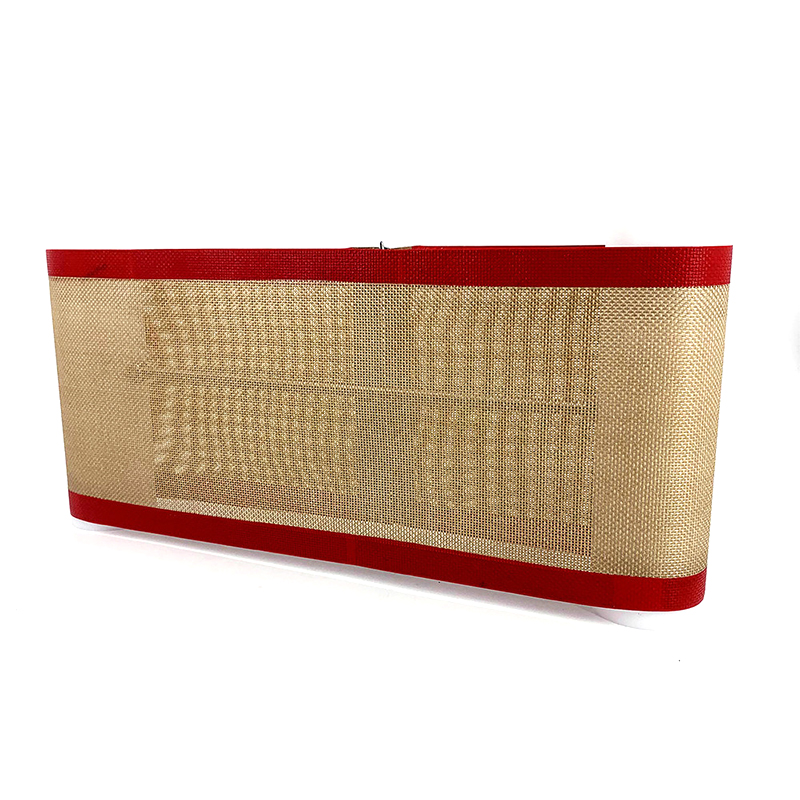
- PTFE Mesh Belts: Open mesh construction with aperture sizes of 1x1mm, 2x2.5mm, 4x4mm, 8x8mm, and 10x10mm for optimized airflow
- PTFE Coated Solid Fabric: Impermeable surface for liquid containment and precision conveying
- Kevlar-Reinforced Belts: Enhanced strength for heavy-load applications requiring moisture resistance
- Seamless PTFE Belts: Continuous construction for fusing machines and applications requiring zero joint interference
Temperature Performance and Thermal Stability
The defining advantage of PTFE conveyor belts is their exceptional thermal envelope. Continuous operation is rated from -70°C to +260°C, with short-term exposure capability up to 360°C. At 250°C continuous operation, belts demonstrate no strength degradation or weight loss after 200 days of testing. Even at 350°C exposure for 120 hours, weight reduction remains below 0.6g, with flexibility preserved at cryogenic temperatures down to -180°C.
This thermal performance stems from the carbon-fluorine molecular bond, one of the strongest in organic chemistry. PTFE maintains its non-stick properties across the entire temperature range, unlike silicone alternatives that begin degradation at approximately 204°C. The material is inherently flame-retardant and self-extinguishing, meeting UL 94 V-0 standards for fire safety.
| Material | Max Continuous Temp | Non-Stick Rating | Chemical Resistance |
|---|---|---|---|
| PTFE | 260°C | Excellent | Excellent |
| Silicone | 204°C | Very Good | Good |
| PVC | 65°C | Poor | Fair |
| Rubber | 93°C | Poor | Fair to Good |
Chemical Resistance and Surface Properties
PTFE conveyor belts demonstrate near-universal chemical inertness, resisting attack from acids, alkalis, and organic solvents that degrade conventional elastomers. This resistance meets ASTM D543 standards for chemical compatibility, making these belts essential in battery manufacturing where sulfuric acid exposure would destroy nylon alternatives within weeks.
The non-stick surface prevents adhesion of resins, paints, hot-melt adhesives, and food products. In adhesive tape production facilities, this property eliminates residue buildup that typically requires frequent cleaning shutdowns. The smooth PTFE surface also prevents scratching of delicate electronic components during reflow soldering processes, while anti-static variants eliminate fiber adsorption in textile operations.
Chemical Compatibility Profile
- Strong Acids: Resistant to sulfuric, hydrochloric, and nitric acid exposure
- Alkalis: Stable in sodium hydroxide and potassium hydroxide environments
- Organic Solvents: Compatible with acetone, ethanol, and hydrocarbon-based solvents
- Oils and Greases: No degradation from petroleum-based or synthetic lubricants
Critical Applications Across Industrial Sectors
PTFE conveyor belts serve as essential components in processes where material contamination, thermal degradation, or product adhesion would compromise output quality. The global market for PTFE glass mesh conveyor belts exceeds USD 850 million, with Asia-Pacific representing the largest consumption region at approximately USD 400 million driven by manufacturing expansion in solar, textile, and electronics sectors.
Food Processing and Packaging
FDA-compliant PTFE belts are deployed in baking ovens, frying lines, and frozen food transfer systems. The non-toxic surface permits direct food contact without contamination risk. In pizza manufacturing plants, belts prevent cheese and sauce adhesion while withstanding oven temperatures up to 260°C. The easy-clean surface supports hygiene protocols requiring frequent high-temperature washdowns at 150°C.
Textile and Screen Printing
Open mesh PTFE belts function as dryer fabrics in textile finishing operations, providing breathable conveyance for heat setting, dyeing, and fabric shrinking processes. The mesh construction allows hot air penetration that reduces heat loss and improves drying efficiency by up to 30% compared to solid belt alternatives. In screen printing operations, belts convey substrates through UV curing and thermal transfer presses without ink adhesion.
Electronics and Automotive Manufacturing
Circuit board reflow soldering operations rely on PTFE belts to withstand peak temperatures while maintaining precise component positioning. Automotive paint shops and glass tempering lines operating at 250°C+ utilize PTFE belts where rubber would melt and metal would conduct excessive heat. In carpet manufacturing, belts convey uncured synthetic rubber backing through curing ovens, with the non-stick surface enabling clean release of bonded materials.
Chemical and Pharmaceutical Processing
Pharmaceutical sterilization lines and chemical drying tunnels employ PTFE belts for their resistance to aggressive cleaning agents and process chemicals. The belts maintain purity standards required for drug manufacturing while enduring continuous exposure to corrosive environments that would degrade standard conveyor materials.
Joint Configurations and Edge Reinforcement
Proper joint selection determines belt longevity and tracking stability in PTFE conveyor systems. Manufacturers offer multiple connection methods tailored to application requirements.
| Joint Type | Construction | Best Application |
|---|---|---|
| Bullnose Joint | PTFE-coated Kevlar mesh | General industrial drying |
| Overlap Joint | Layered fabric overlap | Low-tension conveying |
| Finger Joint | Interlocking fabric fingers | High-flex applications |
| Metal Lacing | Stainless steel mechanical seam | Heavy-load industrial systems |
| Seamless | Continuous woven construction | Fusing machines, precision work |
Edge reinforcement options include heat-sealed PTFE film, PTFE-coated glass fiber borders, and Kevlar guide strips sewn along belt edges. Anti-deviation systems incorporate stamped stainless steel buckles with PTFE or Kevlar guide cords to maintain tracking accuracy on long conveying runs.
Selection Criteria and Specification Guidelines
Specifying the correct PTFE conveyor belt requires systematic evaluation of operational parameters. Belt thickness selection directly impacts thermal performance and service life. Thinner belts in the 0.08 to 0.25 mm range provide minimal thermal insulation for rapid heat transfer but may experience shorter life due to heat concentration. Thicker belts from 0.5 to 1.5 mm offer superior thermal buffering and conformability to surface irregularities, though they add thermal mass that may slow heating cycles.
Specification Checklist
- Determine continuous and peak operating temperatures
- Calculate required tensile strength based on product weight and belt tension
- Select mesh size for airflow requirements or solid surface for liquid containment
- Identify chemical exposure risks from process materials or cleaning agents
- Specify width requirements, available from 5 mm to 2,500 mm
- Choose joint type based on flex requirements and load conditions
- Select edge reinforcement and tracking guides for alignment stability
PTFE coating weight, measured from 100 to 1,000 g/m², determines non-stick layer durability. Higher coating weights provide extended service life in abrasive environments but increase cost. Standard colors include brown, black, and beige, with custom options available for specific industry requirements.
Maintenance Protocols and Service Life Optimization
Under normal operating conditions with proper maintenance, PTFE conveyor belts achieve service life ranging from 1 to 5 years. Critical factors affecting longevity include operating temperature consistency, product abrasiveness, belt tension accuracy, conveyor tracking alignment, and system cleanliness.
Recommended Maintenance Practices
- Inspect belt tracking weekly and adjust tension rollers to prevent edge wear
- Clean surfaces with soft cloths and approved solvents to avoid coating damage
- Monitor for mechanical damage from misaligned product loading or foreign objects
- Verify joint integrity during scheduled shutdowns to prevent catastrophic failure
- Maintain operating temperatures within specified continuous ranges to prevent thermal degradation
A documented case study from a German packaging facility demonstrated that PTFE belts in wax coating applications lasted 3.5 years compared to 8 months for polyester alternatives, generating substantial ROI through reduced replacement costs and eliminated production interruptions. Proper selection and installation remain the primary drivers for maximizing belt longevity and operational efficiency.
Message Us Right Now!

- Phone: +86-18651171105
- Fax: +86-18651171105
- Email: yaxing@yaxing.com
- Address: No. 18, Yongxin East Road, Gaogang District, Taizhou City, Jiangsu Province, China.
Copyright © Yaxing Plastic Industry Co., Ltd. All Rights Reserved. Custom High-End Precision PTFE Series Products Manufacturers 