

 English
 Español
 русский
The Complete Guide to Silicone Baking Mats: What They Are, How to Use Them, and What to Look For
Content
What Is a Silicone Baking Mat?
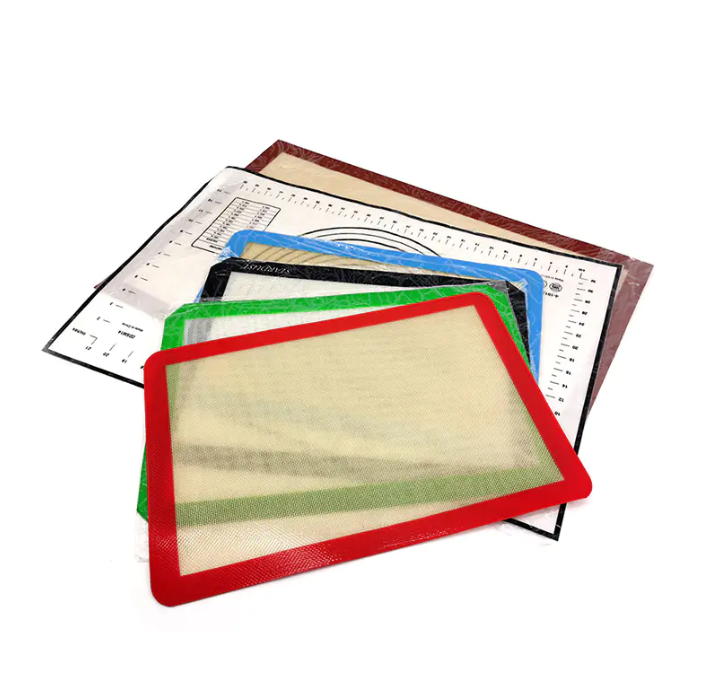
A silicone baking mat is a reusable, non-stick sheet made from food-grade silicone — typically reinforced with a fiberglass mesh core — designed to line baking trays and replace single-use parchment paper or aluminum foil. It provides a stable, non-reactive baking surface that withstands oven temperatures from approximately −40°C to 230°C (−40°F to 450°F), releases baked goods without greasing, and can be washed and reused for hundreds to thousands of baking cycles before performance degrades.
The silicone baking mat was commercially popularized by Demarle in France in the 1980s under the Silpat brand and has since become a standard item in professional pastry kitchens worldwide. Consumer adoption accelerated through the 2010s as home bakers recognized its practical advantages over disposable alternatives — lower long-term cost, consistent baking results, and significantly reduced single-use waste.
How Silicone Baking Mats Are Made
The construction of a quality silicone baking mat involves two core materials bonded together during the manufacturing process.
Fiberglass Mesh Core
Most commercial and professional-grade silicone baking mats are reinforced with a woven fiberglass mesh embedded within the silicone layer. The mesh provides dimensional stability — preventing the mat from stretching, warping, or bunching during use — and distributes heat more evenly across the surface. Without reinforcement, a pure silicone sheet would deform under the weight of dough and shift unpredictably in the oven.
The fiberglass core also gives the mat its characteristic slight rigidity: it lies flat on the baking tray without curling, which is essential for even contact with the pan surface and consistent bottom-heat transfer. Budget mats made from silicone alone, without fiberglass reinforcement, tend to curl at the edges and develop hot spots that cause uneven browning.
Food-Grade Silicone
The silicone compound used in baking mats is platinum-catalyzed food-grade silicone, distinct from the industrial peroxide-catalyzed silicone used in seals and gaskets. Platinum-catalyzed silicone produces no by-products during curing, has no odor or taste transfer, and is certified inert in contact with food across the full oven temperature range. It meets food contact material standards including EU Regulation 10/2011, FDA 21 CFR, and LFGB (Germany) where applicable.
Non-stick performance comes from silicone's inherently low surface energy — most baked goods, including high-sugar items like caramel and toffee that fuse to metal pans, release cleanly from the silicone surface without any oil, butter, or spray. The surface energy of silicone (approximately 20–25 mN/m) is lower than that of PTFE (Teflon) non-stick coatings and significantly lower than stainless steel or aluminum.
Types of Silicone Baking Mats
Not all silicone baking mats serve the same purpose. Several distinct types are available, each optimized for different baking tasks.
Standard Non-Stick Mat
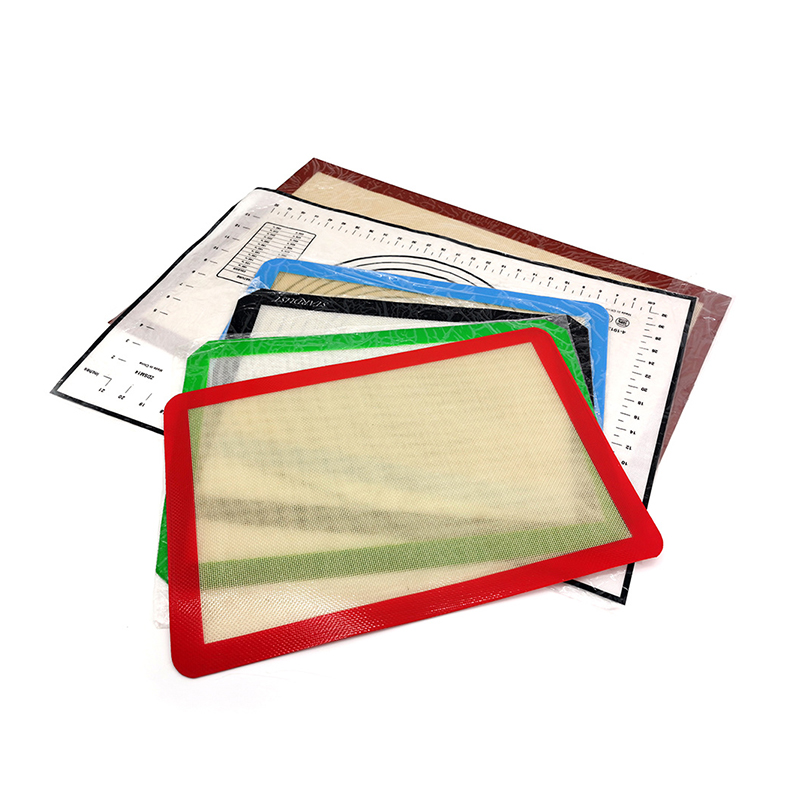
The most common type — a flat, smooth silicone sheet sized to fit standard half-sheet (approximately 30 × 40 cm) or full-sheet (approximately 40 × 60 cm) commercial baking trays. Suitable for cookies, pastries, roasted vegetables, macarons, tuiles, and most general baking applications. This is the direct replacement for parchment paper in the majority of home and professional baking tasks.
Macaron Mat
A specialized variant with pre-printed circles in the exact diameter required for consistent macaron sizing — typically 3.5 cm or 4 cm in diameter, arranged in a grid pattern. The circles serve as piping guides, ensuring uniform size across an entire batch. Some macaron mats also feature a textured or micro-perforated base designed to promote even drying of the macaron foot during the resting phase before baking.
Perforated Silicone Mat
A flat mat with evenly distributed small holes punched through the silicone and fiberglass layers. The perforations allow hot air to circulate directly under the food, producing crispier bases on items like pizza, bread rolls, and croissants. This type is particularly effective in convection ovens where airflow from below would otherwise be blocked by a solid mat. The trade-off is that liquid-heavy items (brownies, bars, tarts) cannot be baked on perforated mats as batter or filling drips through the holes onto the tray below.
Pastry Mat
A larger, thicker silicone mat — often 60 × 80 cm or larger — intended as a counter-top rolling and kneading surface rather than an oven mat. Pastry mats typically feature printed measurement guides, circle templates, and conversion tables. They are used with dough for bread, pie crust, pasta, and fondant work. The non-slip base keeps the mat stationary during rolling without adhesive or suction cups, and the silicone surface releases dough cleanly for easy transfer.
| Type | Key Feature | Best For | Oven Use |
|---|---|---|---|
| Standard non-stick | Smooth flat surface | Cookies, pastries, roasted veg | Yes |
| Macaron mat | Pre-printed piping circles | Macarons, choux, meringues | Yes |
| Perforated mat | Airflow holes throughout | Pizza, bread, croissants | Yes |
| Pastry mat | Large surface, printed guides | Rolling dough, kneading | No |
Silicone Baking Mat vs. Parchment Paper: A Practical Comparison
The choice between a silicone baking mat and parchment paper comes down to frequency of use, baking application, and priorities around cost and waste. Each has genuine advantages that make it better suited for specific situations.
Where Silicone Mats Win
- Long-term cost — A quality silicone mat costs USD 15–30 and lasts for 2,000–3,000 uses according to manufacturer ratings. Compared to parchment paper at USD 0.05–0.15 per sheet, the mat pays for itself within 200–600 uses — typically within the first year for regular home bakers.
- Caramel and high-sugar items — Caramel, toffee, nut brittles, and sugar-work release from silicone far more reliably than from parchment, which can bond to caramelized sugar even when greased. Professional confectioners use silicone mats specifically for this property.
- Consistency — A silicone mat provides the same surface characteristics every use. Parchment paper quality varies between brands and even between sheets in the same roll, affecting non-stick performance and moisture absorption from dough.
- Waste reduction — A single silicone mat replaces hundreds of disposable sheets. For households and businesses with sustainability commitments, this is a meaningful reduction in single-use material consumption.
Where Parchment Paper Wins
- Temperature ceiling — Parchment paper is rated to approximately 220°C (425°F); some silicone mats are rated to 230°C but performance can degrade at the upper limit. For very high-temperature roasting or broiling, parchment (used briefly) or aluminum foil is safer.
- Lining irregular shapes — Parchment can be cut, folded, and shaped to line cake tins, loaf pans, and springform molds. Silicone mats are flat and cannot be shaped to fit vertical or curved surfaces without specialized silicone molds.
- Crispier bottom crust — Parchment paper is thinner and conducts heat more directly to the food base than a silicone mat, which insulates slightly due to silicone's low thermal conductivity. For artisan bread, biscotti, and items where a crisp bottom crust is the goal, parchment often produces better results.
- No washing required — Parchment paper is discarded after use; a silicone mat must be washed after every session. In a professional kitchen producing dozens of trays per service, this difference in turnaround time can be operationally significant.
How to Use a Silicone Baking Mat Correctly
Most baking tasks require no adjustment when switching from parchment to a silicone mat, but a few technique points make a meaningful difference in results.
- Do not grease the mat — Silicone's non-stick properties are intrinsic to the material. Adding butter, oil, or non-stick spray does not improve release and can leave a residue that builds up over time, eventually reducing non-stick performance. The only exception is very lean doughs (such as crackers) that may benefit from a very light spray on first use.
- Place on a rigid baking tray — A silicone mat cannot support its own weight when loaded. It must always be used on a flat, rigid surface — a standard aluminum half-sheet tray is ideal. Attempting to lift a loaded silicone mat without a supporting tray beneath it will cause spills and potential burns.
- Reduce oven temperature by 5–10°C if switching from parchment — Silicone's insulating property means the food base receives slightly less direct heat than on parchment. Some bakers find that reducing temperature marginally and extending baking time slightly produces results more consistent with their parchment-based recipes, particularly for cookies where spread and browning are critical.
- Do not use under a broiler — Broiler elements can exceed 300°C and should never be used with silicone baking mats, even briefly. The mat will discolor, off-gas, and potentially melt at temperatures beyond its rated limit.
- Do not cut on the mat — Knives and bench scrapers will cut through the silicone layer and expose the fiberglass core. Once the surface is cut, the mat can no longer safely contact food and should be replaced. Use a separate cutting board for any portioning.
Cleaning and Storage
Proper cleaning preserves non-stick performance and extends service life. Most silicone baking mats are dishwasher-safe, but the cleaning method matters.
Routine Cleaning
After baking cookies, pastries, or vegetables, the mat typically wipes clean with a damp cloth or can be rinsed under warm water with a small amount of dish soap. Silicone is non-porous, so food residue does not penetrate the surface — it sits on top and releases easily without scrubbing.
For dishwasher cleaning, lay the mat flat on the top rack or roll it loosely and secure with a clip to prevent it from folding onto heating elements. Avoid placing it on the bottom rack near the heating element, which can exceed the mat's rated temperature during the drying cycle.
Removing Grease Build-Up
Over time — particularly if the mat has been greased, or used for high-fat items like roasted meats or butter-rich pastry — an oily film can develop on the surface that regular washing does not fully remove. This film gradually diminishes non-stick performance. Two effective approaches:
- Baking soda paste — Apply a paste of baking soda and a small amount of dish soap to the surface, let sit for 10–15 minutes, then scrub gently with a soft brush and rinse thoroughly. This is the most widely recommended method for restoring non-stick performance without damaging the silicone surface.
- Hot water soak — Submerge the mat in very hot (near-boiling) soapy water for 20–30 minutes to loosen embedded grease, then scrub and rinse. Avoid abrasive pads or steel wool, which scratch the silicone surface and create sites for food residue to accumulate.
Storage
Store silicone baking mats flat or loosely rolled — never tightly folded. A tight fold creates a permanent crease that disrupts flat contact with the baking tray, leading to uneven heat distribution and baked goods that slide toward the fold. Most mats are sold with a storage tube or can be stored rolled inside a baking tray for convenience.
What to Look for When Buying a Silicone Baking Mat
Quality varies considerably between silicone baking mats at different price points. These are the specifications and certifications that reliably separate a durable, food-safe product from a low-quality alternative.
- Food safety certification — Look for mats certified to FDA 21 CFR 177.2600 (USA), EU Regulation 10/2011 (Europe), or LFGB (Germany). These certifications require third-party migration testing to confirm no harmful substances transfer to food at oven temperatures. Uncertified mats from unknown sources may contain fillers or peroxide-catalyzed silicone that can off-gas or transfer taste at baking temperatures.
- Fiberglass reinforcement — Confirm the product description explicitly states fiberglass mesh reinforcement. A mat described only as "silicone" without reinforcement will not lie flat, warp under use, and has a significantly shorter service life.
- Temperature rating — Minimum acceptable rating for general baking is 220°C (425°F). Premium mats rated to 230°C (450°F) provide adequate headroom for most baking applications including high-temperature bread baking.
- Tray fit — Measure your baking tray before purchasing. A mat that is too large will fold up at the edges; one that is too small leaves pan edges exposed and prone to burning. Standard North American half-sheet tray interior dimensions are approximately 30 × 40 cm (11.75 × 16.5 in); European GN 1/1 gastronorm trays measure 53 × 32.5 cm.
- Edge sealing — Quality mats have fully sealed edges where the silicone encapsulates the fiberglass mesh completely. On poorly made mats, the fiberglass mesh is exposed at the cut edges, allowing moisture and food residue to wick into the core — a hygiene concern and a structural weakness that accelerates delamination.
- Thickness — Standard silicone baking mats are approximately 0.75–1.0 mm thick. Thicker mats (1.5 mm+) provide more insulation and better durability for heavy commercial use; thinner mats transfer heat more directly and are better suited to applications where bottom browning is important.
Message Us Right Now!

- Phone: +86-18651171105
- Fax: +86-18651171105
- Email: yaxing@yaxing.com
- Address: No. 18, Yongxin East Road, Gaogang District, Taizhou City, Jiangsu Province, China.
Copyright © Yaxing Plastic Industry Co., Ltd. All Rights Reserved. Custom High-End Precision PTFE Series Products Manufacturers 